
The First Sighting Of Rare Species At Dahl Forest After Ice Storm
The Black-Backed Woodpecker
By Ed Poropat

Late March of 2025 will long be remembered for the severe ice storm that struck central and eastern Ontario. The southern Haliburton Highlands were hit especially hard, with many residents and cottagers enduring extended power outages. The Land Trust’s Dahl Forest was no exception, sustaining significant damage across the property. In several areas, the forest was transformed entirely. Plantations of Red and White Pine collapsed under the weight of the ice, their crowns snapping and leaving behind stands of broken trunks, fallen limbs, and scattered debris.
The HHLT spent months clearing branches and removing downed wires, and work is still ongoing. Only recently has the reserve been able to safely reopen to the public. Many visitors have remarked on the extent of the damage and the dramatic change to the familiar landscape. Once-shaded pathways beneath whispering pines now reveal a tangled and disrupted forest floor.

While the loss is unfortunate, it also marks an important moment in the evolving story of Dahl Forest and the resilience of its natural systems.
Even a storm of this magnitude offered an unexpected silver lining. Nature has a remarkable way of balancing loss with renewal. While some species suffer in the wake of such events, others find opportunity. One such beneficiary is the Black-backed Woodpecker.
This medium-sized woodpecker—distinguished by its golden crown, barred flanks, and glossy black back—is a rare resident of the boreal pockets in the southern portion of Haliburton County. More commonly found farther north, the species thrives in landscapes affected by catastrophic disturbances such as forest fires, windstorms, and now, the 2025 ice storm. Damaged and dying trees, especially newly formed snags, are quickly invaded by insects like beetles. During the first one to two years after such an event, these trees become rich foraging grounds for insect-eating birds, particularly woodpeckers.
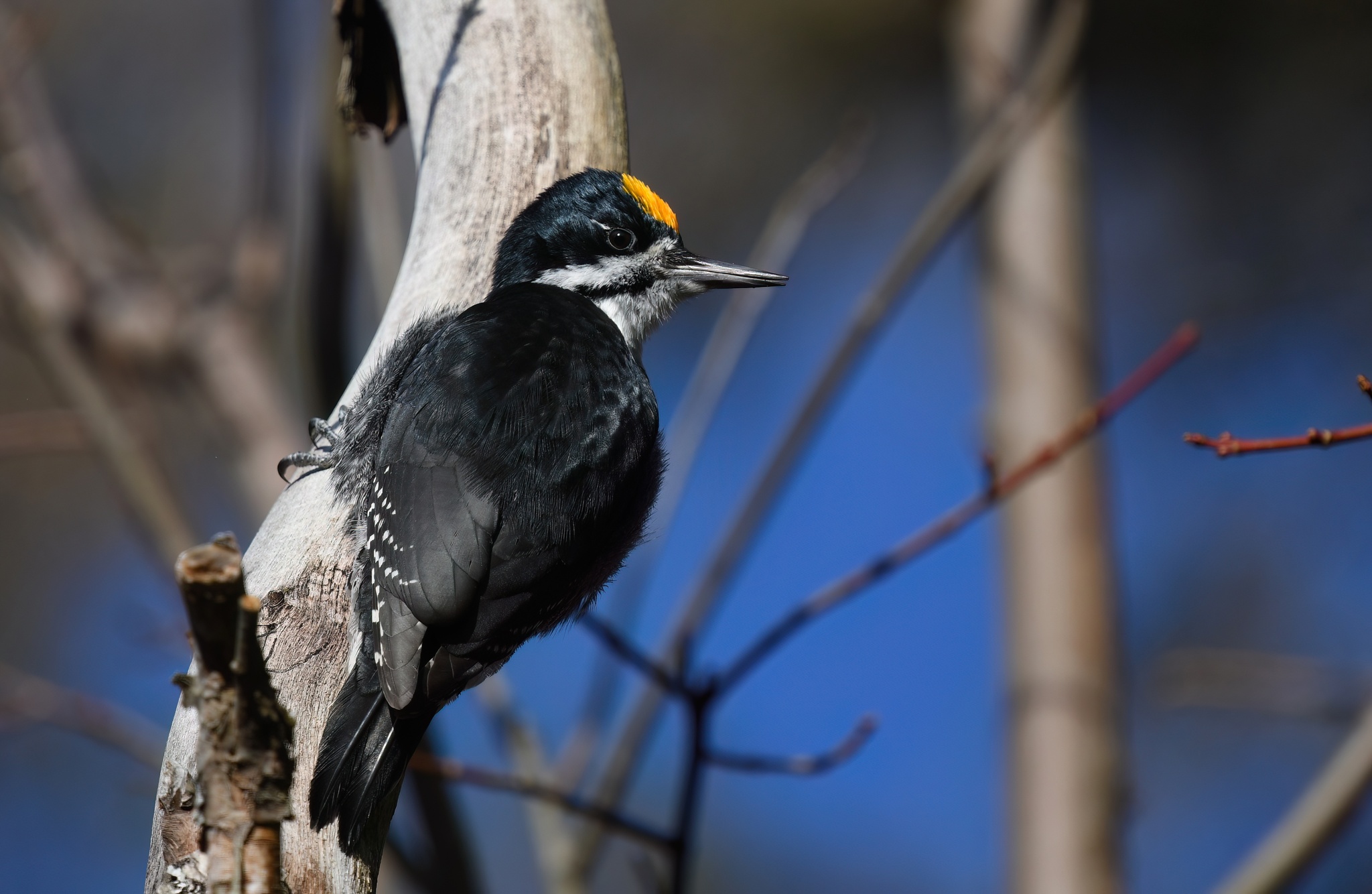
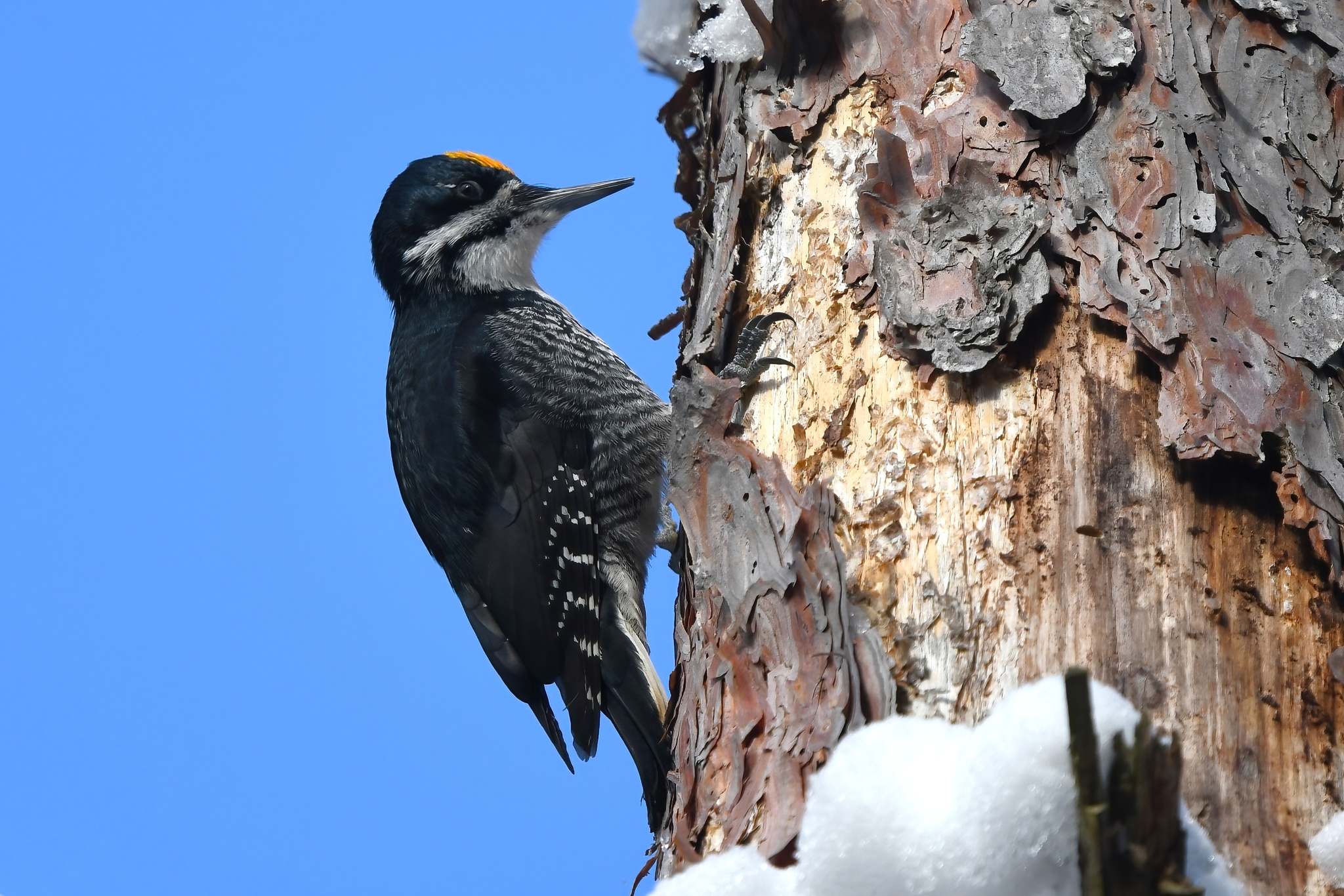
Different woodpecker species use different feeding strategies. Pileated Woodpeckers excavate deep into wood to reach carpenter ants, while Downy and Hairy Woodpeckers focus on larvae just beneath the bark. Black-backed Woodpeckers, however, specialize in extracting insects found within the bark layer itself. Rather than drilling, they “scale” the bark, flaking off loose pieces to uncover beetle larvae hiding underneath. A scattering of bark flakes on the snow beneath a tree is often a clear sign that a Black-backed Woodpecker is nearby.
Recently, during a cool mid-November day, volunteers conducting the annual perimeter check of Dahl Forest encountered a single female Black-backed Woodpecker on the south side of the river. This sighting marked a new species record for the property and was cause for genuine excitement, given the bird’s rarity. But the surprise did not end there. A follow-up survey just days later revealed at least seven individuals actively using the reserve—both males and females—even though the survey was limited to the established trail system.
How did so many of these typically scarce birds locate Dahl Forest so quickly? And if such numbers can appear in a short span, why aren’t we seeing more wandering individuals elsewhere in southern Haliburton County? A single detection would have been notable; seven was exceptional. With the extent of storm damage across the property and in the region, it is possible that even more will arrive. Although this species is known to irrupt occasionally, no such movements appear to be occurring elsewhere in the province at this time. It also raises the intriguing question of whether the even rarer American Three-toed Woodpecker might make an appearance this winter. Only time will tell.

The newly opened canopy and extensive debris may also benefit another threatened species in our region—the Eastern Hog-nosed Snake. These snakes prefer open, sunny habitats—areas with a mix of forest edges, clearings, and rock barrens on well-drained sandy soils. The 2025 ice storm has created an abundance of exactly this type of environment. As a result, it will be interesting to see whether the Eastern Hog-nosed Snake also responds positively to the recent habitat changes at Dahl Forest.
So, as you walk or snowshoe the trails of Dahl Forest this winter, keep an ear tuned for soft tapping in newly opened clearings—a sound that may signal the presence of a Black-backed Woodpecker. With a bit of luck and patience, you might even catch a glimpse of one of these uncommon and striking birds. And as you take in the storm’s impact throughout the reserve, remember that nature is never static—it is always adapting, renewing, and shifting in unexpected ways. What will Dahl Forest reveal to us next?